How to Measure Face Shape: A Simple Four-Measurement Method
Use a mirror, a flexible tape or ruler, and four consistent measurements to get a practical starting point for identifying your face shape.

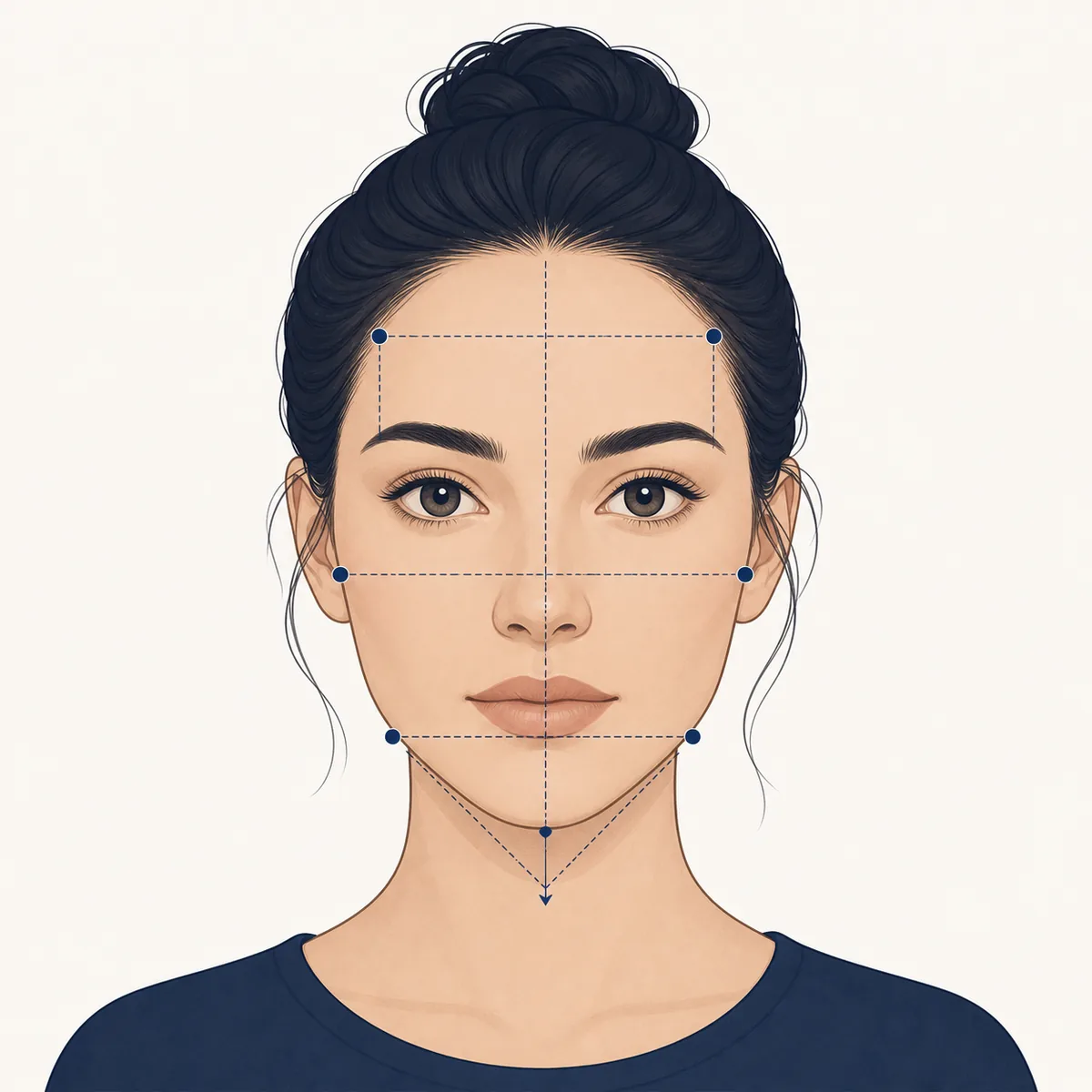
If you are asking how to measure face shape, start with proportions rather than a beauty rule. Tie your hair back, look straight into a mirror, and record face length, forehead width, cheekbone width, and jawline width. These numbers will not produce a perfect scientific label, but they make the comparison clearer and help you understand why a face may look oval, round, square, oblong, heart-shaped, or diamond-shaped.
The four measurements at a glance
Measure from the top of your forehead to the bottom of your chin, then compare the widest part of your forehead, cheekbones, and jawline. If you want a photo-based second opinion, use the face shape detector after recording your own measurements so you can compare the result instead of relying on one guess.
Quick method
Face length + forehead width + cheekbone width + jawline width. Take each measurement twice, use the same units, and compare the relative pattern rather than one isolated number.
What you need before you measure
You can measure face shape with simple household items. The goal is consistency, not laboratory precision.
- Flexible tape or ruler — A soft tape is easiest, but a ruler and a mirror also work if you measure in short straight sections.
- Mirror and hair tie — Keep hair away from the forehead, cheeks, and jaw so the visible outline does not change the result.
- Notes app or paper — Write down the four values immediately and label the units, such as centimetres or inches.
- Neutral light — Use even light and a relaxed expression so shadows do not make the cheekbones or jaw look wider.
How to take each face-shape measurement
Stand upright with your head level. Do not pull the tape tightly against the skin. If you are using a photo, use a front-facing image with minimal perspective distortion and measure the same landmarks on the image.
1. Measure face length
Measure from the centre of the hairline to the lowest point of the chin. If your hairline is difficult to see, use the top of the visible forehead and note that the result is an estimate.
2. Measure forehead width
Find the widest horizontal distance across the forehead, usually between the fuller points above the temples. Keep the tape level rather than following the curve of the skull.
3. Measure cheekbone width
Measure across the most prominent points of both cheekbones. This is often the widest part of the face, but do not assume it is widest until you compare it with the forehead and jawline.
4. Measure jawline width
Measure from the chin to the angle of the jaw on one side, then double that number. This avoids wrapping a flexible tape around the face and gives you a comparable width.
| Measurement | Where to measure | What it helps you compare |
|---|---|---|
| Face length | Hairline to chin | Whether the face is short, balanced, or noticeably long |
| Forehead width | Widest horizontal forehead line | Whether the upper third is wider than the jaw |
| Cheekbone width | Most prominent cheekbone points | The widest central part of the face |
| Jawline width | Chin to jaw angle, doubled | Whether the lower third is broad, narrow, or tapered |
How to read the proportions
There is no single cutoff that defines everyone. Use the measurements as a pattern check, then look at the outline and jaw angle in a neutral photo.
- Oval — Face length is longer than width, while the forehead and jawline look balanced and the jaw is softly rounded.
- Round — Face length and width are relatively close, with fuller cheeks and a softer, less angular jawline.
- Square — Forehead, cheekbones, and jawline can look similarly broad, with a more defined or angular lower edge.
- Oblong — Face length is clearly greater than width, with fairly even forehead, cheekbone, and jaw widths.
- Heart — The forehead is often wider than the jaw, and the chin narrows or tapers toward the bottom.
- Diamond — Cheekbones are the widest area, while the forehead and jawline appear narrower by comparison.
If two types seem close, the existing face shape calculator can compare the same facial landmarks from a clear photo and return a closest match plus confidence context.
Use a neutral photo to check your measurements
A photo is useful when your hair, expression, or mirror angle makes the outline hard to judge. It should support your measurements, not replace them.
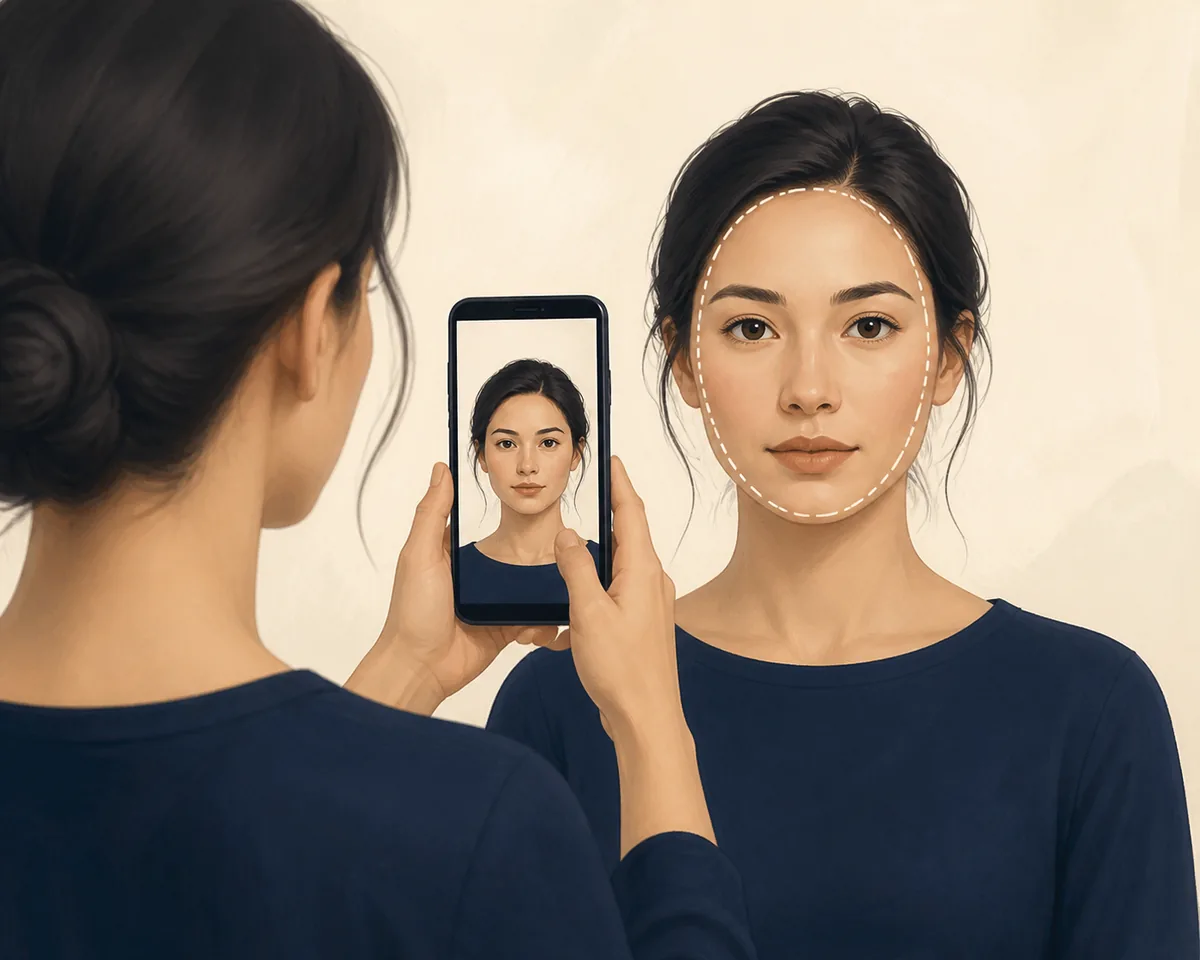
- Face the camera — Keep your nose and chin near the centre of the frame. A three-quarter angle changes apparent width.
- Keep the camera at eye level — Low or high angles can exaggerate the jaw, forehead, or chin.
- Use even lighting — Soft front light makes the hairline, cheekbones, and jaw edge easier to see.
- Relax your expression — A wide smile can change cheek width and jaw tension, so use a natural resting expression.
- Avoid wide-angle selfies — Very close phone photos can enlarge the centre of the face and distort the proportions.
Manual measurement vs an online face-shape tool
Manual measurements are helpful when you want to understand the reasoning. An online tool is faster when you want a repeatable photo comparison, especially if your face has mixed traits.
| Method | Best for | Main limitation |
|---|---|---|
| Tape or ruler | Learning your proportions and checking glasses or hairstyle guides | Small landmark or unit errors can change the comparison |
| Neutral photo | Seeing the overall outline and jaw angle | Lighting, lens distance, hair, and expression affect the image |
| AI-assisted tool | Getting a quick closest-match estimate from one clear photo | It is an estimate and should not be treated as a definitive identity or biometric result |
After measuring, you can use the face shape test to compare the result with a photo-based test and decide whether your proportions fit one clear type or a mix.
Common mistakes and limits
Face shape is a practical category, so a borderline result is normal. Treat the label as a guide for styling and self-understanding rather than a fixed verdict.
- Hairline uncertainty — A fringe, shaved hairline, or receding hairline can make face length difficult to measure.
- Mixed shapes — You may have an oval face with a square jaw or a heart-shaped forehead with a softer chin. More than one description can be useful.
- Photo distortion — A close lens, tilted head, or strong shadow can change apparent width more than a small measurement difference.
- No medical meaning — Face-shape categories do not diagnose health, personality, attractiveness, or identity.
How to measure face shape FAQ
Summary: measure first, then compare
To measure face shape, record face length, forehead width, cheekbone width, and jawline width under consistent conditions. Compare the overall pattern with a neutral photo, allow for mixed traits, and use an online tool as a second opinion rather than a final judgment.